
Criminal Court Cases in Wayne County
Wayne County Superior Court hears felony cases and other matters within Georgia's general-jurisdiction court. State Court handles misdemeanors and matters assigned to it by state law. The Clerk of Courts manages Superior, State, and Juvenile records at 174 N. Brunswick St. in Jesup. Juvenile files follow strict confidentiality rules and do not function as ordinary public criminal records.
Municipal courts are separate. Jesup, Screven, and Odum handle city ordinance, traffic, and fine-only matters within their authority. A city citation may never appear in the Wayne County Superior or State Court index. The charge level and issuing court on a citation, warrant, or bond paper are often the fastest clues to the right custodian.
Call Wayne County's Court Clerk
The direct route begins with the Wayne County Clerk of Courts. Call (912) 427-5930 and provide the full spelling of the name, an approximate filing year, and a case number if known. Give a date of birth only when staff requests it to separate similar names. Ask whether the index or docket can be inspected at the counter and whether copies can be sent by email or mail.
Request the register of actions first. That short docket can identify the accusation or indictment, bond order, plea, judgment, sentence, and final disposition worth ordering. No official copy-fee schedule was located, so ask about search, per-page, certification, postage, and electronic-delivery charges before placing an order.
The official clerk directory confirms the office and courts it manages. Its Wayne County listing is shown below.
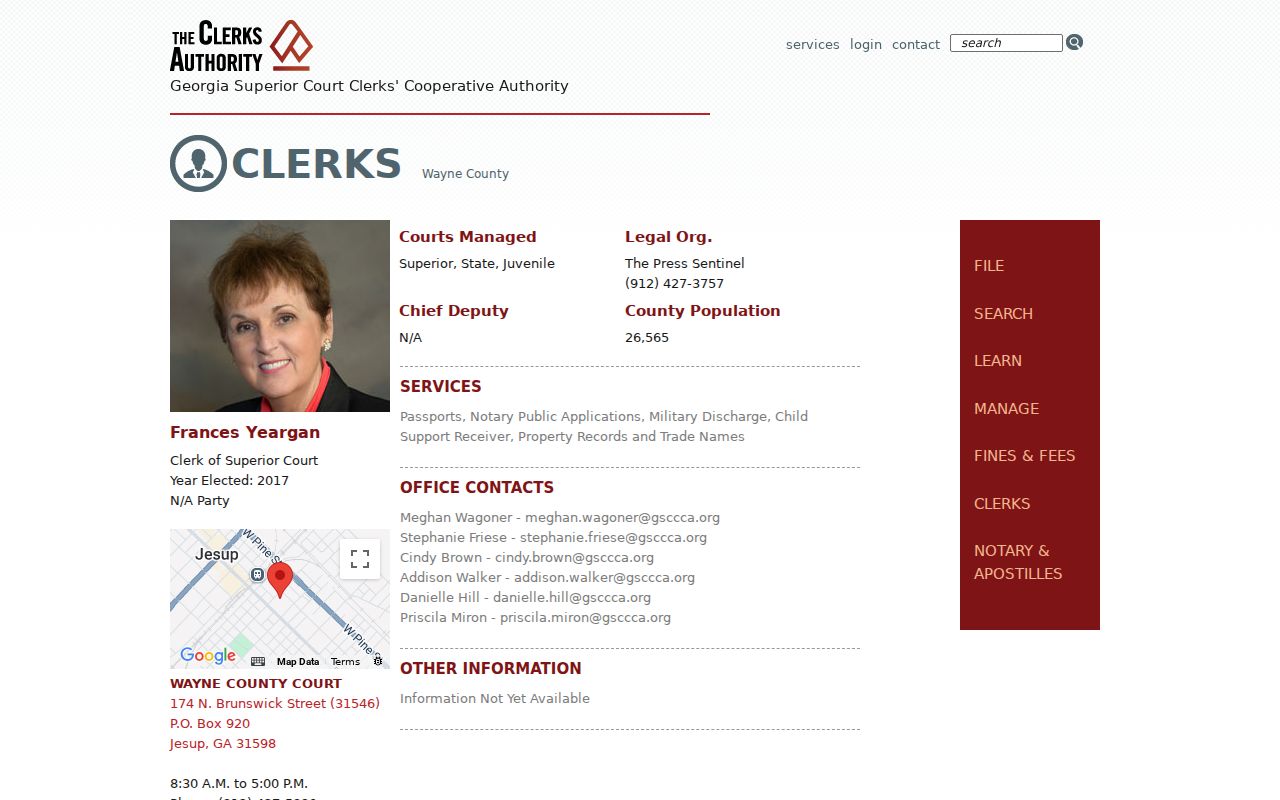
The directory helps confirm that a request is going to the official custodian rather than a private case-search service.
Wayne County Case Record Searches
Georgia Courts provides an E-Access directory rather than one unified statewide case database. Wayne Superior and State Courts are linked to PeachCourt. The provider requires an account before searching, and the public fields, date coverage, document prices, and sample results could not be verified without registration. Do not assume that an e-filing listing guarantees a complete public name search.
- Classify the matter as felony, misdemeanor, city, or juvenile.
- Call the clerk with the name, filing year, and case number.
- Ask for the index or docket before ordering full documents.
- Confirm copy, certification, search, delivery, and postage charges.
- Check the arresting agency or municipal court if no filed case appears.
The Georgia e-filing provider table identifies PeachCourt for Wayne's Superior and State Courts.
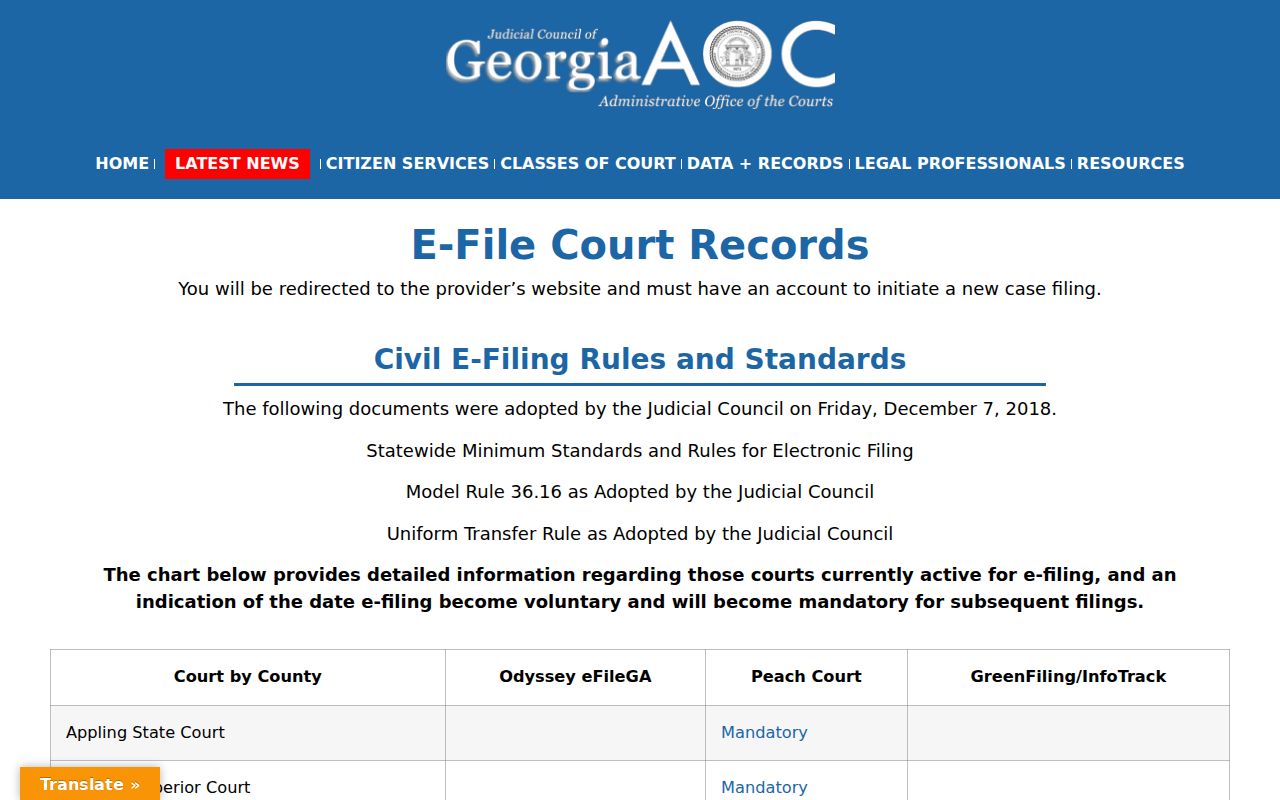
That listing identifies the provider, but it does not replace a call to the clerk when an account search is incomplete.
| Request field | Best use | Limit |
|---|---|---|
| Full name | Locate a party index entry | Similar names may require another identifier |
| Case number | Open one known file | Must match the court's format |
| Approximate year | Narrow a clerk search | Arrest and filing years can differ |
| Court level | Separate Superior, State, and municipal files | Initial charges may later change |
| Date of birth | Distinguish names if requested | Protected data may not appear publicly |
Superior or State Court?
Follow the filed charge, not merely the booking label. A felony generally belongs in Superior Court. A misdemeanor generally belongs in State Court, while a city traffic or ordinance case may stay in municipal court. Prosecutors can reduce, add, or replace charges after arrest, so the court file can differ from the initial jail entry.
Superior Court is part of the Brunswick Judicial Circuit. The circuit supplies judicial administration across Wayne and neighboring counties. The District Attorney files and prosecutes cases, while the clerk keeps the public court record. The District Attorney's Wayne office page confirms the local circuit contact.
This division of duties matters: ask the prosecutor about charging action and the clerk for filed pleadings, docket events, orders, and disposition copies.
What a Criminal Case File Contains
A Wayne County criminal court file records the case after filing. It may contain more detail than a name-search result, including the exact counts, docket history, bond orders, plea or verdict, sentence, and later orders. Start with the docket, then request only the documents needed to understand the outcome.
| Case header | Case number, court, filing date, assigned judge, type, and status. |
|---|---|
| Parties | State of Georgia, defendant display, and public counsel information. |
| Charges | Counts, Code sections, offense dates, and felony or misdemeanor level. |
| Docket | Filed events, hearings, calendar entries, motions, and order dates. |
| Bond | Amount, type, conditions, and modification or revocation orders. |
| Outcome | Plea, verdict, dismissal, nolle prosequi, dead docket, or conviction. |
| Sentence | Confinement, probation, credit, costs, and public special conditions. |
“Nolle prosequi” means the prosecutor chose not to proceed on that charge. “Dead docket” means prosecution is suspended rather than resolved by a finding of guilt. Neither term should be read as a conviction.
Read Wayne County's Docket First
A docket is a map of the file. Compare the filing date, charge count, and latest disposition entry before paying for pages. An accusation or indictment states filed charges. A judgment records the legal outcome. The sentence order sets the court's terms. Bond orders address release conditions but do not prove guilt.
If the outcome line is blank, ask the clerk whether a later order exists. Then compare the clerk's disposition with the individual's GCIC history when reviewing one's own record. A missing state disposition may be a reporting gap. GBI requires documentation from the court, prosecutor, or other contributing agency before GCIC can correct the state record.
Wayne County publishes a local criminal-history and disposition-copy page.
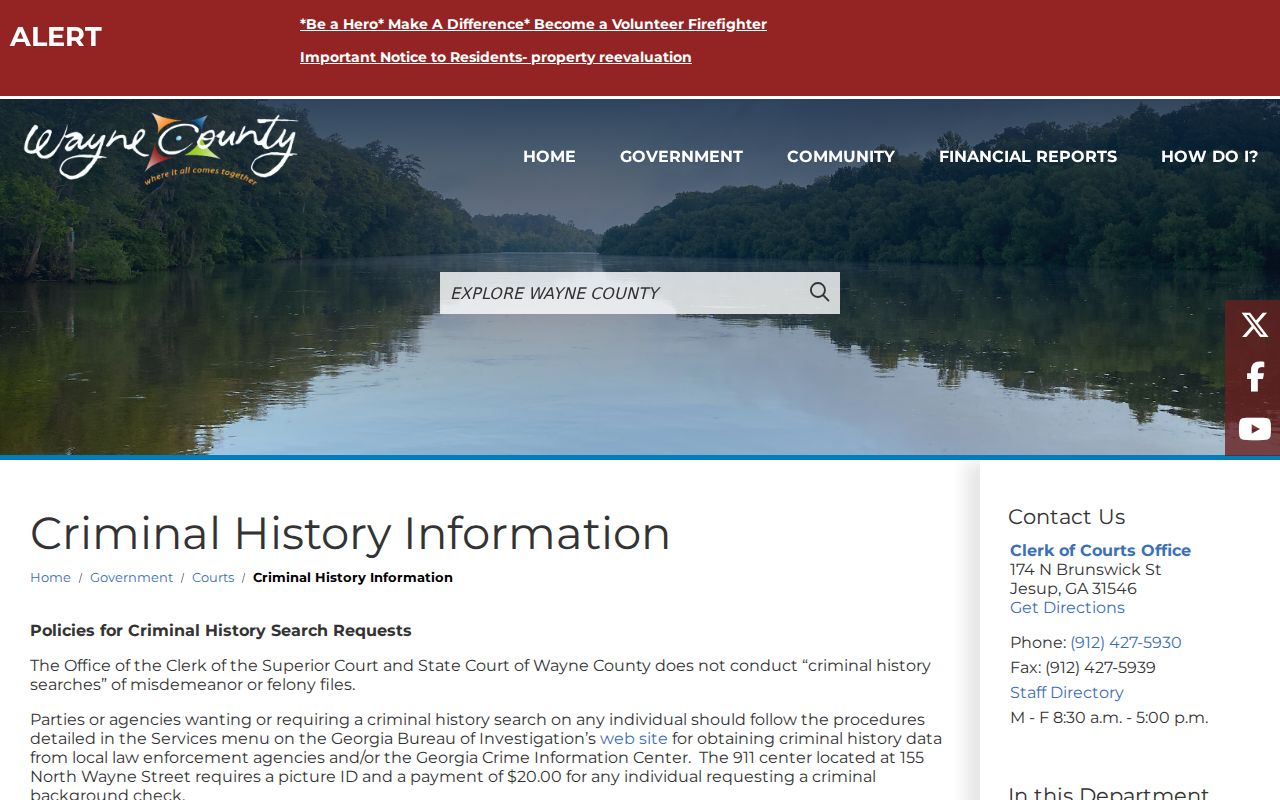
The county route is useful when a searcher needs the official disposition behind a state history entry.
Criminal Case Stages in Wayne County
The court record begins when charges are filed, not when the arrest occurs. At arraignment, the accused is formally advised of the filed charge and enters a plea. Pretrial entries can include discovery, motions, hearings, and bond changes. A plea or trial then leads to a disposition. A sentence follows a conviction, while dismissal or nolle prosequi ends a count without a guilty finding.
Case flow: Charges Filed › Arraignment › Pretrial › Plea or Trial › Disposition › Sentencing
The District Attorney may file charges that differ from the booking sheet. The circuit public defender represents eligible accused people, but it is not the court-file custodian. The Brunswick Circuit Public Defender page illustrates that separate role.

For pleadings and outcomes, return to the Wayne County clerk even when another circuit office handled part of the case.
When Wayne County Finds No Case
No clerk result can mean the matter is too new, was never filed, belongs to a municipal court, is in another jurisdiction, or is confidential. First ask the arresting agency whether an incident or arrest report exists. Then call the relevant city court for a citation or ordinance matter. For a filed adult case, check both Wayne Superior and State Court.
Federal cases go to the U.S. District Court for the Southern District of Georgia and PACER, not Wayne's clerk. A search involving a booking rather than filed charges may also require the county's arrest-search routes. Keep each record type separate so an absent court result is not mistaken for proof that no arrest happened.
Access Rules for Wayne County Cases
Georgia law favors access to public records, but court files also follow judicial rules. Juvenile matters, sealed or restricted records, protected victim information, medical details, and confidential identifiers can be withheld or redacted. An online view may contain less than the official paper file. Ask the clerk whether a record exists but is unavailable through the chosen channel.
The Georgia Open Records Act, O.C.G.A. §§ 50-18-70 through 50-18-77, applies to existing agency records and allows lawful redaction. It does not require an office to create a report or give legal analysis. Court access is not always identical to an executive-agency request, so use the clerk's court-record process first. Georgia record restriction does not automatically erase every local court document; eligible sealing may require a separate court order.